









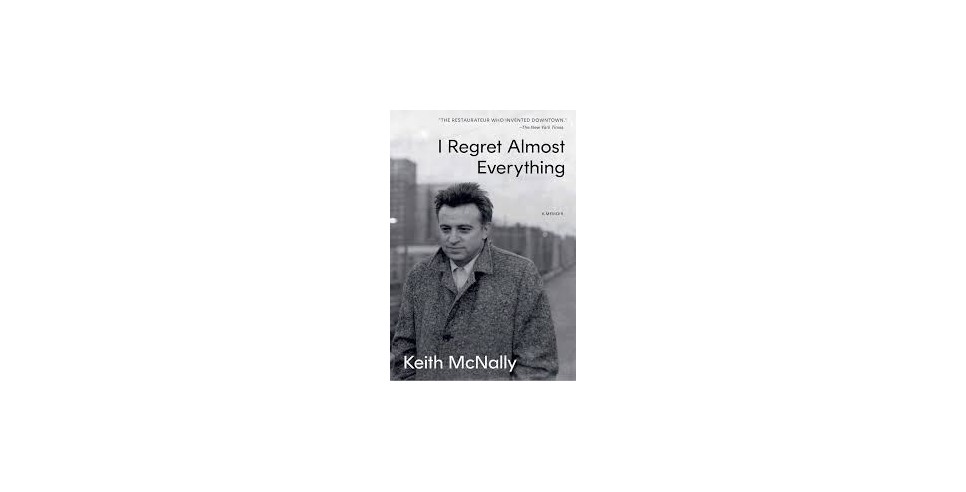
I Regret Almost Everything
By Keith McNally
Gallery Books, an imprint of Simon & Schuster
303 pp
I stumbled upon Keith McNally’s memoir in my usual awkward, almost bumbling fashion. I happened to be in New York City with a friend. I had long promised to take her to Balthazar for breakfast. Four empty tables away sat a man alone with his laptop and a book. Astonished that he sat at a table for so long without being gently prodded to get on with it to make room for the next guest, I struck up a conversation.
I asked him what he was working on.
He pointed to the book on his table: I Regret Almost Everything by Keith McNally.
I still didn’t make the connection.
I told him: I was just a working-class girl from Yonkers.
Unbeknownst to me, he was holding court at his table in an informal author event. He owned Balthazar and had been hailed by the New York Times as “The Restaurateur Who Invented Downtown.” I was relieved that he didn’t try to make me feel like a rube for not knowing who he was. Instead of learning a lesson in humiliation, my faux pas ended up becoming a New York Story.
One New York Story leads to another.
I told Mr. McNally that I would review his memoir. I’ve read and reviewed plenty of books so doing so would be my way of saving face.
Most memoirs are not good stories, or memorable enough to inspire an authentic following. I’ve been unkind to memoirists. The great Irish writer Edna O’Brien had “a sotto voce literary voice that was both gravelly and haunting with the melodic fluidity of aging wine,” but her memoir Country Girl took all the fun out of the bawdy escapades of her life. And most recently, Belle Burden’s Memoir Stranger was a “tell-all about nothing at all.”
Mr. McNally’s book is different. He imparts lessons about life that you were too afraid to know. At the pinnacle of his career, he was an extremely fit sixty-five year old man who through “no stroke of luck,” had a massive stroke, and lost his speech and the ability to use the right side of his body. “So much for the restaurateur who invented downtown,” he stated blithely in his book.
When the stroke leaves him disabled and dependent, he contemplates taking his own life and almost succeeds. Between the man he is now and the man he was during his heyday, there is an inevitable clash, a vivid rendering of a work in progress that is worthy of our attention. McNally delivers more than a memoir, he gives us a conceptual blueprint for how to succeed against the odds.
His background was decidedly hardscrabble—that is quickly established, but what hasn’t been spelled-out is that being from the working-class is both a great blessing and a great curse. McNally grew up in the working-class neighborhood of Bethnal Green in east London. His two older brothers spared him no mercy, neither did his parents, his friends, or the schools where he found himself dislocated from his primary ambition—to find a way to get out of there.
By sixteen he was out of there, and onto a life in the theater world, somewhat; he landed a role in Alan Bennett’s play Forty Years On. For the most part, playwright Alan Bennett became McNally’s long-term mentor, and at one point, his romantic partner. It is through Alan Bennett and director Jonathan Miller that McNally first experiences art and culture that far exceed life among the working-class in Bethnal Green.
Once a working-class person musters the courage to leave home, inevitably a rare form of claustrophobia creeps into every new environment. In McNally’s case, the London theater scene becomes as stifling as growing up in Bethnal Green. Once unrest sets in, it’s time to go on the road again. He embarks on a solo journey that takes him all over the world. He quotes Italian artist Giorgio Morandi, “one can travel this world and see nothing.” McNally obviously traveled the world and saw everything.
While traveling thirty miles from the Nepalese border, he embraces his confounding habit “of abandoning goals once they became graspable.” Throwing off the shackles of what creatively confines him ultimately becomes the great pattern of his life. The constant pursuit of one gargantuan project after another, from filmmaking to the many restaurants he famously opened in New York City, is where McNally’s story begins and also where it ends.
In 1975, McNally moved to New York City, where he took entry level restaurant jobs and quickly rose through the ranks. This is the upside of having a strong working-class ethic. Now for the curse: he was often beset by self-loathing and self-recrimination—those twin conditions bedevil him, and at the same time, they are the very traits that will forever keep him out of Bethnal Green.
His talent as a storyteller is borne of masterful self-education, and curiosity. Leaving school at age sixteen did him no harm. Celebrities, friends, family members, wives and lovers make entrances and exits with the aplomb of actors in a cast of thousands. Everyday people, physical therapists, orderlies, massage therapists, are bit players who walk on and upstage the big stars in the show.
Make no mistake, Keith McNally’s memoir is a New York Story.
Any person who goes to New York City, like McNally did, and is young, smart, ambitious, willing to work hard, with a sprinkling of verve, raw talent, and a modicum of good looks to wit, will almost always get a come-up from the right people.
“It’s never about wealth, religion, or politics. It’s always about the individual. Always,” McNally said. He is a real person whose bluster hardly masks profound sensitivity. This is a must-read for anyone who grapples with life’s lessons, including the questions you have been too afraid to ask of yourself.
Keith McNally: Fanfare For The Uncommon Man is an essay in my collection NOTES FROM THE WORKING-CLASS.

Patricia Vaccarino
Patricia Vaccarino is an accomplished writer who has written award-winning film scripts, press materials, articles, essays, speeches, web content, marketing collateral, and eleven books.